


What to see in Formentera: the complete guide 2026
Formentera is not just an island; it is an emotion that begins even before you set foot on its shores. That scent of juniper, rosemary, and sea salt that greets you the moment you step off the ferry is the sign that you have arrived in a place where time has decided to slow down. Often described as the last pearl of the Mediterranean, this island has successfully resisted overdevelopment, protecting a wonderful and fragile ecosystem.
Once you have planned the practical details, such as booking your accommodation in Formentera and purchasing your Ibiza to Formentera ferry tickets, the real adventure begins. But what makes Formentera so magnetic? It’s not just its crystal-clear waters, but that unique blend of hippy spirit, Mediterranean architecture, and untouched nature that glows under the Balearic sun.
In this guide, we will explore every corner, from the lonely lighthouses to the Caribbean-like beaches, from the spectacular pink salt pans to the legendary hippy markets, to give you the definitive answer to the question: what to see in Formentera?


The lighthouses: island sentinels between sky and sea
The profile of Formentera is shaped by legendary lighthouses that dominate the island’s extremities. These are not merely navigational landmarks, but places of introspection where the land ends and the horizon becomes infinite.
Faro de La Mola: the guardian of dawn and the Jules Verne myth
Inaugurated in 1861, the Faro de La Mola is the oldest lighthouse on the island, perched on a majestic cliff 120 meters high. This is the easternmost point, where the morning light first touches the “isla bonita”. Walking toward the edge feels like standing on a balcony suspended over the abyss. The La Mola plateau has a wild character and a microclimate of its own: the air is cooler than on the coast and filled with the scent of the Mediterranean scrub.
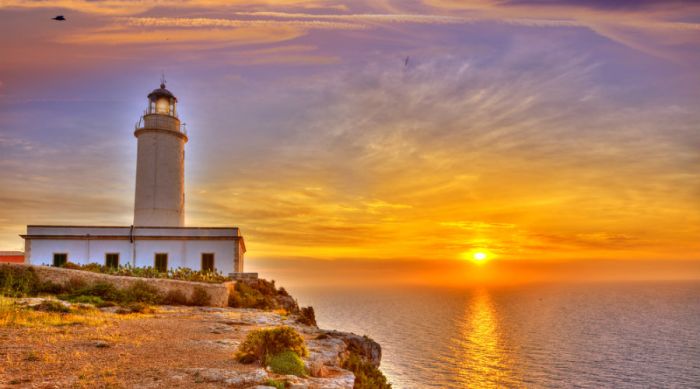
A literary curiosity: Jules Verne was so fascinated by this location that he mentioned the La Mola promontory in his novel “Off on a Comet“, symbolically describing it as the “end of the world”. This image still perfectly captures the essence of this part of the island today. A commemorative plaque next to the lighthouse celebrates this link between literature and reality.
We recommend visiting at sunrise to see the sun emerge directly from the sea, or on Wednesday and Sunday afternoons, when the nearby artisan market transforms the silent atmosphere into a vibrant gathering of artists, craftsmen, and musicians.
Faro de Cap de Barbaria: the last sunset and the Cova Foradada
At the far south, facing the African coast, stands the most photographed lighthouse on the island, made famous by the cult film Lucía y el sexo. The road leading there is a hypnotic straight line that cuts through an arid, almost lunar landscape, where the vegetation grows low to withstand the winds.
To preserve this delicate ecosystem, motor vehicle access is restricted during high season. The best way to visit is to rent a scooter in Formentera, park in the designated area, and enjoy the approximately 2 km walk in absolute silence, broken only by the sound of the cicadas.
Just a few meters from the lighthouse, on the right, lies one of the island’s best-kept secrets: Cova Foradada. This is a natural cave in the ground, accessible by descending a small wooden ladder. Once inside, the cave suddenly opens onto the cliffside, offering a natural “window” over the cobalt blue sea. It is the perfect spot for those seeking a moment of solitude and one of the most spectacular sunsets in the entire Mediterranean.


The beaches: a Caribbean illusion in the heart of the Mediterranean
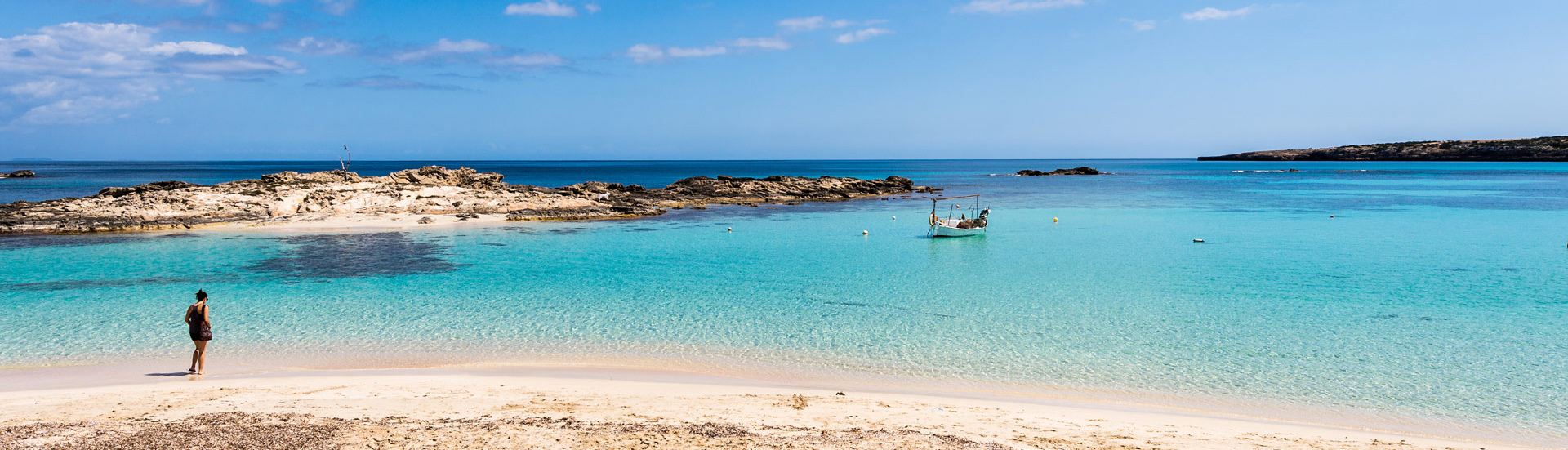
Thanks to the presence of Posidonia Oceanica (a UNESCO World Heritage site), a seagrass that acts as a natural “lung” for the sea, Formentera’s waters boast a transparency that rivals the most exotic tropical destinations.
Ses Illetes: nature’s perfection
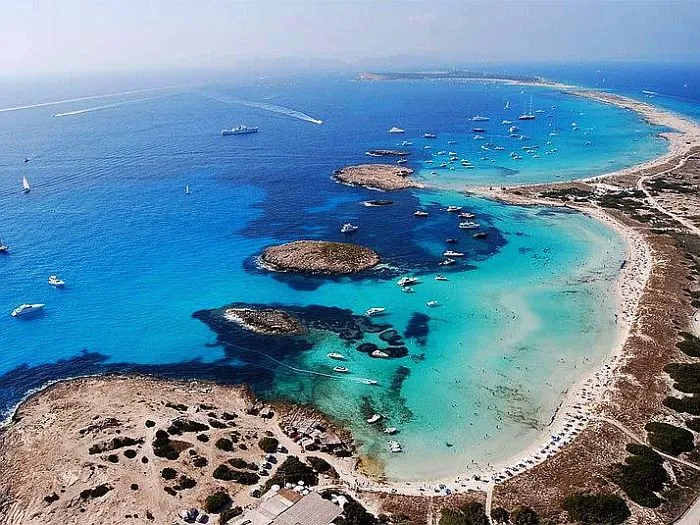
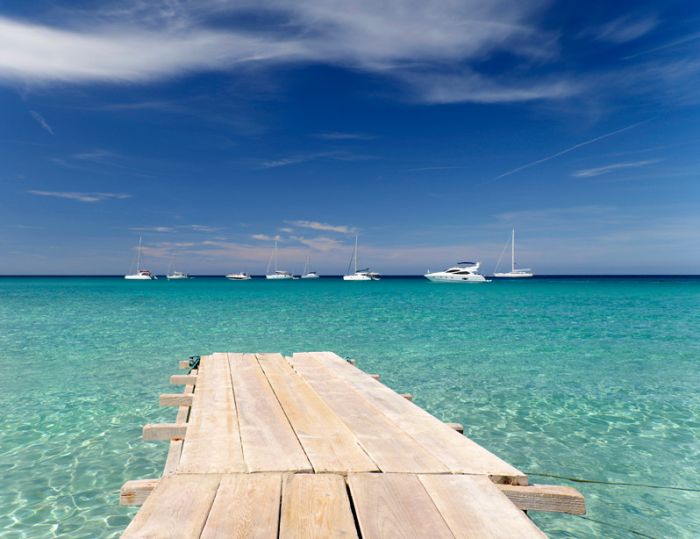
Located on the northern tip of the island within the Es Trucadors peninsula, Ses Illetes is consistently ranked among the most beautiful beaches in the world. It is a narrow strip of fine white sand lapped by turquoise waters on both sides. As part of a protected Natural Park, access is limited and requires a small toll for motor vehicles.
Insider Tip: Don’t just stop at the beginning of the beach, where tourists arriving by boat from Ibiza tend to gather. Walk further north, toward the point where the land thins out, almost touching the island of Espalmador.
If you are looking for an exclusive lunch, the area is home to famous restaurants like Es Molí de Sal and Juan y Andrea, favorite spots for celebrities and superyachts. However, if you prefer to avoid the often prohibitive prices of these venues and enjoy the beach in a simpler, more dynamic way, we recommend bringing a packed lunch.
Playa de Llevant: the other side of paradise
Located right on the opposite side of Ses Illetes is Playa de Llevant. Often ignored by lazier tourists, this beach offers towering dunes and slightly choppier seas, ideal for those seeking an authentic connection with the island.
A suggestion: When the wind blows from the west, Llevant becomes a flat, wonderful pool, often much less crowded than its famous neighbor.
Playa de Migjorn: kilometers of wild coastline
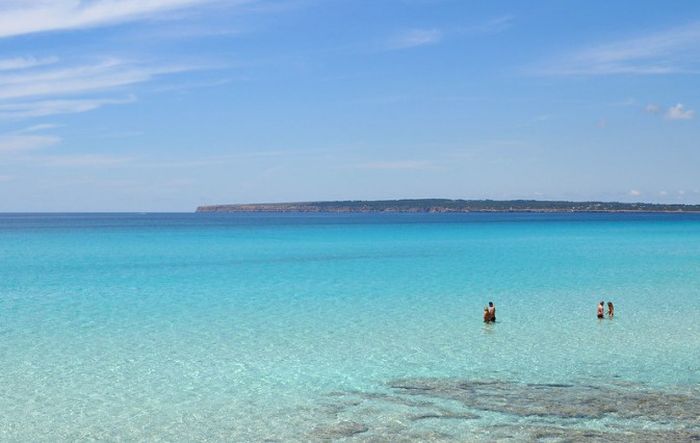
Stretching over 5 km, Playa de Migjorn is the longest and most diverse beach on the island. It is divided into various sections named after local areas, such as Ca Marí, Es Arenals, and Es Copinar. Here, nature is the absolute protagonist, with a dune system protected by wooden walkways that allow you to explore the coast without damaging the local flora.
This is the ideal beach for those who have rented a car in Formentera, thanks to the numerous parking areas and easy access points. Along Migjorn, you will find some of the island’s most iconic beach bars, such as Karai, Gitana, Amar, and KM11, as well as historic venues like the Blue Bar, with its unmistakable psychedelic atmosphere.
Caló des Mort: a precious gem among the rocks
Hidden at the end of the long Migjorn coastline, Caló des Mort is a tiny crescent-shaped bay nestled between ochre-colored cliffs and ancient “escars“ (traditional wooden fisherman huts). Here, the sea is a natural turquoise pool, so clear that every detail of the seabed is revealed.
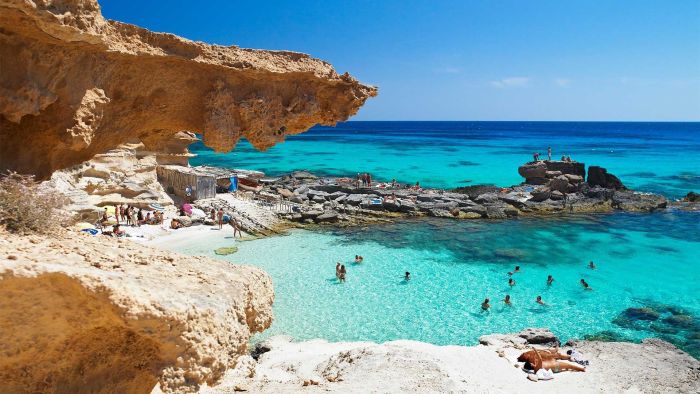
The descent requires some care along a dirt path, but the view from above is one of the most iconic on the island. It is the premier spot for morning snorkeling: the rocky seabed is populated by rich marine life that seems unfazed by human presence.
The villages: white souls and “vida lenta”
Between one swim and the next, take some time to discover the island’s inland centers, where life still flows at the rhythms of a bygone era.
Es Caló de Sant Agustí: the fisherman’s village
Located at the foot of the climb to La Mola, Es Caló is perhaps the most authentic corner of Formentera. It is famous for its ancient “escars“ that allow fishermen to haul their boats ashore. These walkways, declared a site of cultural interest, combined with the emerald waters of the bay, create a landscape that feels frozen in the last century. From here starts the Camì de sa Pujada, a scenic trail that climbs toward La Mola, offering what is arguably the most breathtaking view of the entire island.
Sant Francesc Xavier: the beating heart
The administrative capital of the island, Sant Francesc is a small gem of elegance and simplicity. The main square is dominated by the 18th-century fortified church. Its solid architecture, stripped of superfluous decoration, serves as a reminder of a past when the island had to constantly defend itself against raids by Saracen pirates.
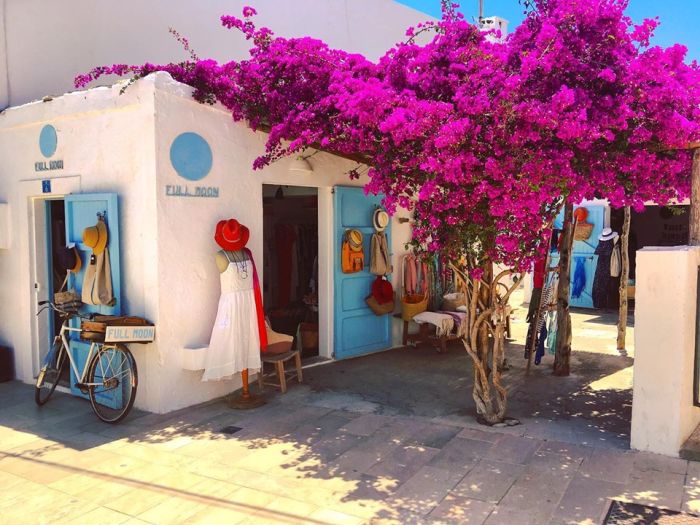
Today, Sant Francesc is the ideal place to get lost among design boutiques, enjoy a break at the famous Cafe Matinal, or simply admire the contrast between the whitewashed houses and the deep purple of the bougainvillea.
Sant Ferran de Ses Roques: the hippy legacy
Less touristy than Es Pujols, Sant Ferran is the guardian of the island’s bohemian spirit. In the 1970s, it became a meeting point for international artists, including Bob Dylan and Pink Floyd. The nerve center of the village is the legendary Fonda Pepe, a venue that has kept its authentic atmosphere intact for decades. In the evening, Sant Ferran’s square comes alive with art markets where local painters and sculptors exhibit their work under the stars.
Ses Salines Natural Park
Declared a Natural Reserve in 1995, the salt pans represent one of the most fascinating and historically rich stops on the entire island. This is not just a picturesque landscape, but a living testament to Formentera’s ancient economy: as far back as the Phoenicians and Romans, “white gold” was extracted from these areas, and for centuries, salt remained the island’s only true commercial resource.
Birdwatching in Formentera: discovering the pink flamingos
The salt pan area, located in the north between La Savina and Es Pujols, offers an incredible display of colors. During the summer, thanks to the presence of a specific microorganism (Dunaliella salina), the water in the basins takes on a stunning vivid pink hue during the salt crystallization process.
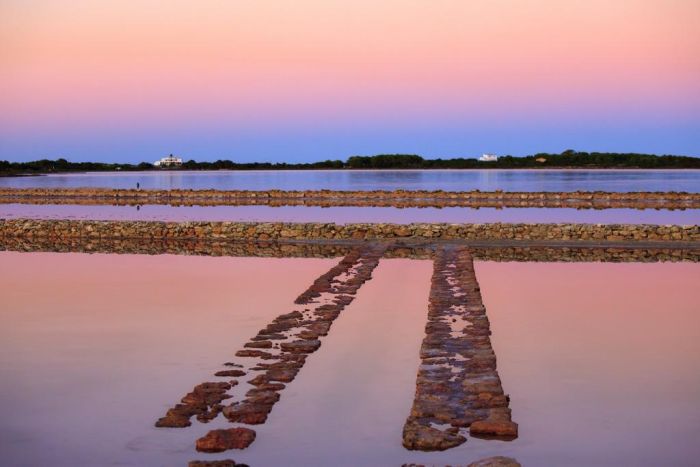
It is a paradise for photographers and birdwatching enthusiasts: here, you can spot elegant pink flamingos (especially between August and October), herons, black-winged stilts, and numerous migratory species that choose the lagoons of Estany Pudent and Estany des Peix as their sanctuary.
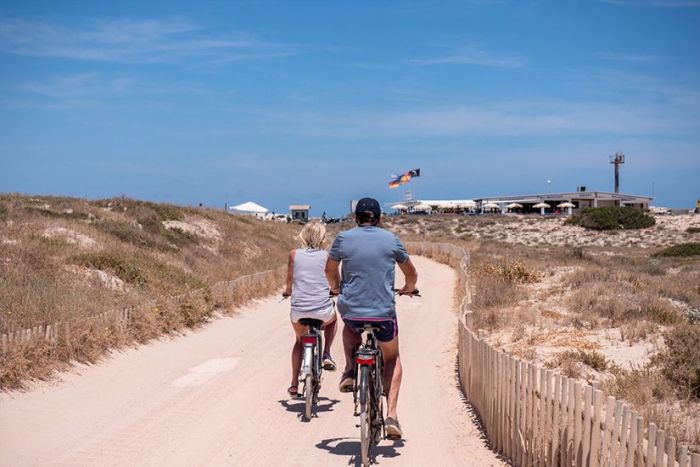
The best way to visit? By bicycle, riding along the flat dirt paths at sunset, when the light reflects off the water’s surface, creating a truly magical atmosphere.
History and archaeology: millennial roots
Many people believe that Formentera was “born” with the tourism boom of the 1960s, but its history stretches back thousands of years.
The megalithic tomb of Ca na Costa
Few travelers know that near Es Pujols lies one of the most significant archaeological sites in the Balearic Islands: the Ca na Costa megalithic tomb. Dating back to the Bronze Age (between 2000 and 1600 BC), the remains of this funerary structure prove that the island was inhabited since ancient times. It is a place filled with mystery, situated between the lagoon and the sea, well worth a silent and respectful visit.
The windmills: stone giants against the blue
Before becoming a top tourist destination, Formentera was known as the “island of wheat”. The constant Mediterranean breeze was harnessed by numerous windmills, some of which have been beautifully restored and are now open to the public.
The most famous is the Molì d’en Vell in La Mola (1778). Here, you can still admire the original, ingenious wooden mechanism used to grind grain into flour for the entire local community.

The defense towers: bastions against pirates
Along the coastal perimeter of Formentera stand the majestic defense towers, built primarily in the 18th century to spot and signal the arrival of pirate ships that once plagued the Mediterranean. These towers were not just observation posts, but true fortresses that communicated with one another using smoke signals by day and fire by night.
The most suggestive towers to visit
- Torre des Pi des Català: located near Migjorn beach, this is the most iconic of the defense towers. It is the only one on the island that has been restored to allow interior visits, offering a rare opportunity to climb to the upper platform for a 360-degree view.
- Torre des Garroveret: situated at Cap de Barbaria, it is one of the best-preserved towers and offers an incredible view of the horizon.
- Torre de sa Punta Prima: near Es Pujols, this tower dominates the cliffs and provides a privileged view of the silhouette of nearby Ibiza and the islet of Tagomago.
- Torre de sa Gavina: located on the western coast, it is the ideal destination for a solitary hike among rocks sculpted by salt and wind.
Visiting these towers is like stepping back in time, imagining the lookouts who once scanned the horizon for dangers that have today been replaced by peace and slow tourism.

Hippy markets: the art of the handmade
Visiting Formentera without losing yourself among the stalls of an artisan market is an unforgivable sin. In a world dominated by mass production, craftsmanship here survives as a true art form: every object, whether a piece of jewelry, leatherwork, or ceramics, contains a little piece of the island. These markets are where the hippy spirit of the 1960s continues to vibrate, offering a magical atmosphere of live music, colors, and pure creativity.
- La Mola market (Wednesdays and Sundays): this is undisputedly the king of the markets, located in the central square. Its unique feature? To exhibit here, artisans must reside on the island year-round and create their products strictly by hand. This guarantees absolute authenticity. Strolling through the stalls while a local band plays live is an experience that reconciles you with the world.
- Es Pujols market: held every evening on the pedestrian seafront. It is the liveliest and most popular, perfect for a relaxing walk after a day in the sun. Here you can find silver jewelry with clean lines, custom-made sandals, and decorated straw bags, all against the backdrop of the town lights and the sound of waves crashing just a few meters away.
- Sant Francesc market: located among the picturesque streets of the historic center, it is perfect for those who love morning shopping. While the bars in the square fill up for breakfast, the stalls display light fabrics, wooden objects, and local products. It’s the ideal chance to buy a precious souvenir before hopping on your scooter and heading to the beach.
- Sant Ferran art market: much more than a simple market, this is a true open-air art exhibition. Here, painters and sculptors who have chosen Formentera as their muse display works inspired by the island’s light and colors. The atmosphere is intimate and bohemian, ideal for those seeking a unique piece of art and wishing to chat directly with the artist under the starry sky.
Image Gallery
-
- The crystal-clear water of Migjorn
-
- Wooden pier at Ses Illetes
-
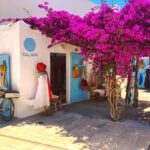
- Shop en Sant Francesc