


Getting around Formentera: scooter, car, or bike?
Few paved roads, no traffic lights, and an endless network of dirt tracks: Formentera is an island to be savored slowly. Its wild nature has been preserved over the years thanks to the protection of the Consell Insular, which, by avoiding excessive urban development, has managed to keep intact that primal charm that makes it unique.
Once you have completed the crossing on the Ibiza Formentera ferry and set foot in the port of La Savina, the question arises naturally: how to get around Formentera?
The answer is not as simple as it might seem. Choosing the right mode of transport means finding the perfect balance between the desire for adventure and the need for comfort, taking into account key variables: the period of your holiday, your budget, and, above all, the accommodation you have chosen (if you haven’t done so yet, explore our selection of houses for rent in Formentera).
From iconic dusty roads to be explored by scooter to the numerous green routes designed for those who love to move on foot or by bicycle, every journey becomes a way to immerse yourself in the authenticity of the island. In this guide, updated for 2026, we will analyze every means of transport, providing practical tips and essential bureaucratic information to help you experience Formentera mindfully and without stress.
1. Getting around by scooter: the symbol of freedom
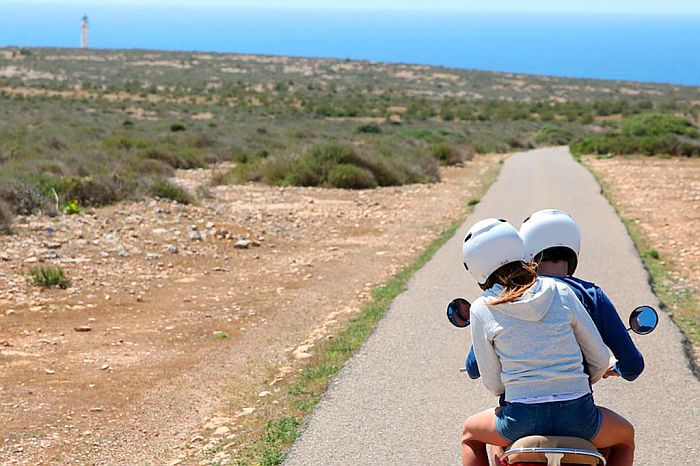
For many, Formentera and the scooter are an inseparable duo. It is the vehicle that embodies the carefree, hippy soul of the island, allowing you to move easily between beaches and breathe in the scents of the Mediterranean scrub.
If you want to live this experience, our advice is to rent a scooter in Formentera before your departure. The availability of vehicles decreases drastically during high season, and booking in advance guarantees you will find the model you prefer.
Technical requirements and licenses
Spanish law is extremely strict regarding the operation of motor vehicles. Here is what you need to know before proceeding:
- 50cc and 110cc engine capacity: to rent, you must be of legal age (18+). A Category B (car) or AM license is required, but remember that the latter, if obtained by minors, has no international validity and is not accepted by local insurance companies.
- 125cc engine capacity: for these models, the most requested for stability with two people, you must have held a Category B license for at least 3 years. Without this time requirement, the rental company cannot provide the vehicle.
- Carrying passengers: the minimum age to travel as a passenger on a motorcycle is 12 years old, reduced to 7 years only if the driver is a parent or legal guardian.
Practical tips for rental
To reserve a scooter, you need a valid driving license and a credit card. When picking up your vehicle, pay attention to a few key details:
- Insurance: always check what the policy covers. You can pay a small daily fee to waive the excess and enjoy peace of mind.
- Helmet quality: verify that they are the correct size and in good condition. Remember that 125cc scooters with a top box are the most practical, as they allow you to store both helmets while you are at the beach.
- Opening hours: always check the motorent hours, especially for the return on your departure day, to avoid finding them closed during the lunch break.
Where to park and how to avoid fines
In Formentera, checks are constant and fines are heavy. Scooters can only be parked in spaces marked by white lines or in designated dirt ground areas.
It is strictly forbidden to park on sidewalks, between two parked cars, or inside protected dune areas. Towing is a daily occurrence during the high season.
Safety and road conditions
The freedom of two wheels requires caution. Driving on dirt tracks is drastically different from asphalt: accumulations of sand and gravel make the ground slippery and are the main cause of low-speed falls. It is important to remember that at night, secondary roads are completely dark and require extreme caution.
Furthermore, even in July and August, the evening temperature drop can be noticeable: bringing a sweatshirt or a light jacket for the ride back is always a smart move. Finally, as tempting as it may seem, riding in swimwear or flip-flops is strongly discouraged for safety reasons.


2. Getting around Formentera by car: comfort and convenience
If you are traveling as a family, with small children, or in a group of friends, renting a car in Formentera is often the smartest choice. Besides offering protection from the sun and the comfort of air conditioning, a car provides the necessary space for beach umbrellas, cool boxes, and daily groceries.
Since the number of vehicles on the island is limited compared to scooters, booking in advance is essential to avoid being left stranded, especially during the high season.
The timeless icon: the charm of the Mehari
You cannot talk about cars in Formentera without mentioning the Citroën Mehari. This “beach buggy” has been the undisputed symbol of the island since the 70s: easy-going, brightly colored, and strictly spartan. Renting one means giving up power steering and central locking to embrace a unique hippy-chic style.
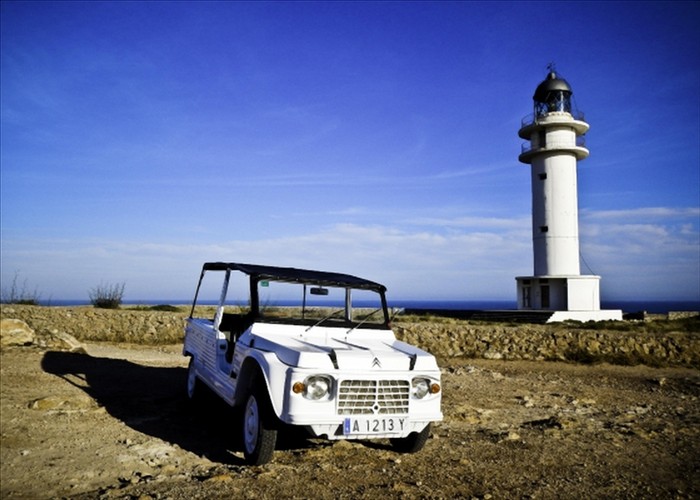
Keep in mind that, as it is almost entirely open, it is not ideal in case of strong winds or rain and does not allow you to leave valuables inside. If you are looking for a memorable experience and do not need excessive comfort, the Mehari (now also available as the electric E-Mehari) remains the most photogenic travel companion on the island.
The parking jungle: the color code
Parking in Formentera requires attention to avoid immediate fines. The system is based on specific road markings:
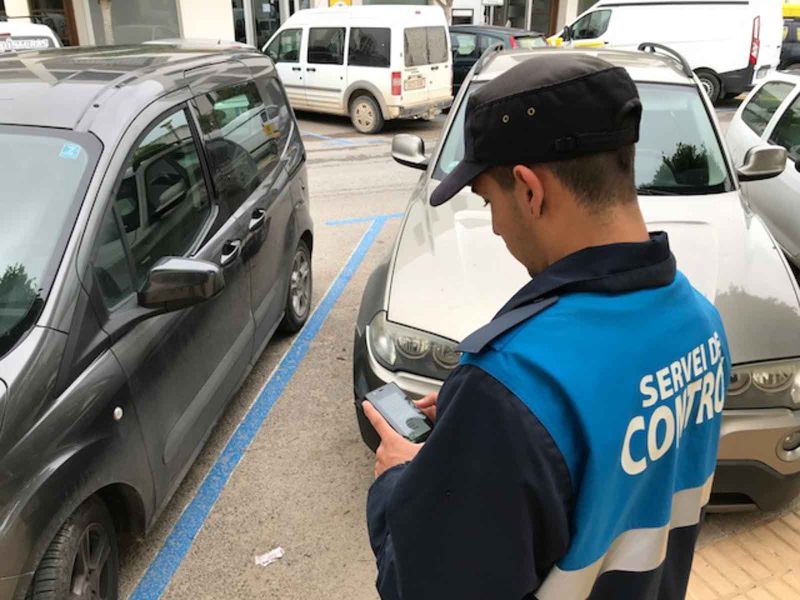
- Blue Lines: indicate paid parking, found mainly in the centers of Es Pujols, Sant Francesc, and Sant Ferran.
- White Lines: indicate free parking, usually located in more peripheral areas.
- Yellow Lines: zones for loading and unloading goods; parking is strictly prohibited.
- Green Lines: reserved exclusively for residents (very common in La Savina). For a tourist, parking here almost certainly means receiving a fine or having your vehicle towed.
In some centers, free parking for only 30 minutes is available (marked by the number 30 on the asphalt): it can be used only once a day and still requires a ticket (physical or virtual). In unregulated dirt areas, the rule of common sense applies: make sure you never obstruct the passage of other vehicles or pedestrians.
Technology to the rescue: the Flowbird Parking app
To manage parking in blue zones without having to find a parking meter or carry coins, the essential application is Flowbird Parking. This app allows you to set the parking duration and pay directly by credit card.
The main advantage? If you decide to stay an hour longer, you can extend your parking time directly from your smartphone without having to physically return to the car.


3. Getting around by bike: the green soul of the island
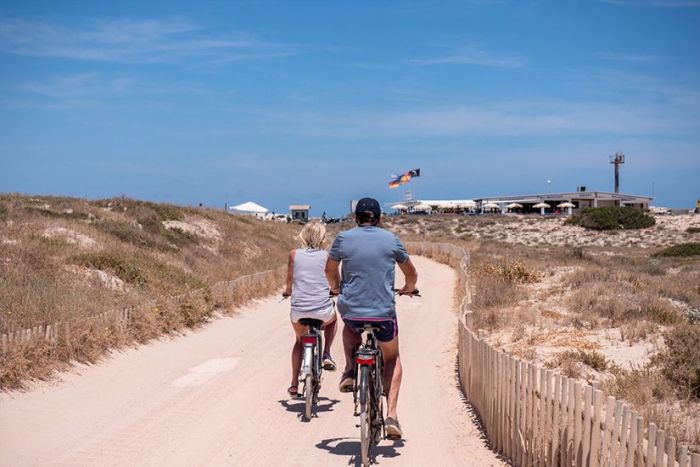
Renting a bicycle in Formentera is not just a transport choice, but a true travel philosophy. It is the most eco-friendly and respectful way to get in sync with the island, allowing you to savor its scents and unique landscapes far from the roar of engines. If you are looking for an authentic experience, we recommend checking out the bicycle rental options in Formentera to choose the model that best suits your needs.
Traditional vs. electric bikes
The choice between the two depends heavily on your physical fitness and your goals for the day:
- Traditional bike: perfect for short, flat trips, such as the route between the port of La Savina and the salt pans. It is the ideal choice for those who want to stay fit, though keep in mind that summer heat and headwinds can make even a few miles feel like hard work.
- Electric bike: this is the real game-changer for island mobility. Pedal-assist allows you to effortlessly tackle the climb to the La Mola plateau or reach the Cap de Barbaria lighthouse in total silence, arriving at your destination fresh even during the hottest hours.
The green routes (rutas verdes)
The island boasts 32 signposted cycling routes, known as “rutas verdes“. These paths, which once connected the island before cars became common, wind through dry-stone walls, scenic fig trees, and ancient “fincas”. Cycling along the path bordering Estany des Peix at sunset or crossing vineyards where placid goats graze is an experience no motor vehicle can match.
Practical advantages and tips
Choosing a bicycle offers immediate benefits not only for the environment but also for your wallet:
- Free access to Ses Illetes: the bicycle is the only vehicle (along with pedestrians) that can enter the Ses Salines Natural Park for free, avoiding the fees required for cars and scooters.
- Families and children: models are available for all ages, including bikes equipped with certified child seats, making two-wheeled excursions a favorite activity for families.
- Safety and parking: as there are not many bike racks, it is best to park sensibly without obstructing the way. For night-time travel, due to the poor lighting on secondary roads, it is preferable to rely on a taxi.

4. Services and alternatives: buses and taxis
Not everyone wants the responsibility of a rental vehicle or feels like searching for parking under the sun. For those seeking a more relaxed holiday or traveling in a group, Formentera offers a public transport network and private services that cover the island’s main points in detail.
Getting around by bus: the “slow” approach
If you prefer not to drive, there are excellent alternatives for how to get around Formentera without a private vehicle. Using the bus is an eco-friendly choice, ideal for those with a bit of patience who don’t mind a short walk (stops are often on the main road). Lines are active from approximately 7:00 AM to 10:00 PM, and tickets can be purchased directly on board (€1.80 to €2.55 depending on the route). Here are the main ones:
- L1 (circular): the most dynamic line. It connects the port of La Savina with the centers of Es Pujols, Sant Ferran, and Sant Francesc.
- L2: links the port to the Ca Marí area (Migjorn) and goes up to the village of El Pilar de la Mola. It is the perfect line to reach the hippy market on Sundays and Wednesdays.
- L5: the direct connection to the stunning bay of Cala Saona.
- L7: an essential shuttle linking tourist areas (Es Caló, Es Pujols) to Ses Illetes beach, helping to ease traffic in the Natural Park.
Taxi service: 24/7 convenience
Taxis are the best solution for families with children, those traveling with lots of luggage, or for late-night returns after dinner. The service is available 24 hours a day, and the main stands are located at the port, in Es Pujols (near the information office), and in Sant Francesc (near the ice cream shop La Mukkeria).
- Fares: taxis do not use a meter but a fixed rate table. A ride from the port to Es Pujols costs on average between €15 and €18. Note: from 9:00 PM to 7:00 AM and during weekends (from Saturday afternoon to Monday morning), night and holiday surcharges apply.
- Contacts: the number to save is Radio Taxi (+34 971 32 23 42). In August, demand is extremely high, so factor in possible waiting times.

5. Regulations and restrictions: Formentera.eco
This is the most critical chapter for anyone considering bringing their own vehicle to Formentera. The Formentera.eco project aims to limit the number of vehicles to preserve the island’s tranquility and environmental balance.
- Private vehicle limitations: during the summer months (June–September), the access of private cars and motorcycles is regulated by a maximum cap. You must request authorization through the official website and pay a daily fee. Spaces are limited and often sell out well in advance.
- The ban on rentals from Ibiza: it is vital to know that you cannot rent a vehicle in Ibiza and take it by ferry to Formentera. This practice is prohibited for two main reasons: first, Formentera.eco regulations strictly forbid entry to rental vehicles from outside the island; second, Ibiza rental companies explicitly exclude insurance coverage once the vehicle leaves the island.
- Renting on the island: if you rent a car or scooter directly in Formentera, you don’t need to worry about these formalities. Local rental companies already have the necessary circulation permits included in their service, and roadside assistance is guaranteed across the entire territory.
- Refueling tips: unless your vehicle is electric, remember that there are only two gas stations on the island: one between Sant Ferran and Sant Francesc, and another on the road to the port (coming from Sant Francesc). Planning your refueling will save you from a last-minute rush before boarding your return ferry.
Ultimately, deciding how to get around Formentera depends entirely on your preferences: whether it is the wind in your hair on a scooter or the comfort of a car, the most important thing is to enjoy every mile of this paradise.